Parts Join/Renew Mail Us Home Officials Events Gallery Magazine Links Regalia
Commemoration of the Centenary of George Singer's death.
Singerfolk from both the Association of Singer Car Owners and the Singer Owners’ Club, met in Coventry on 4 September 2009 to continue their commemoration of the life of George Singer, whose death on 4 Jan 1909 they had remembered on 4 Jan 2009 with a visit to his grave in the London Road cemetery, attending the morning service at St Thomas’ Parish Church and a visit to George’s home at Coundon Court.
										*															*															*															*															*														*														*													*															*
This  time we started with a visit to the original Singer works in Canterbury Street, the main facade and entrance hall of which have been preserved and incorporated into ‘Singer Hall’ - a hall of residence for students at  University of Coventry.
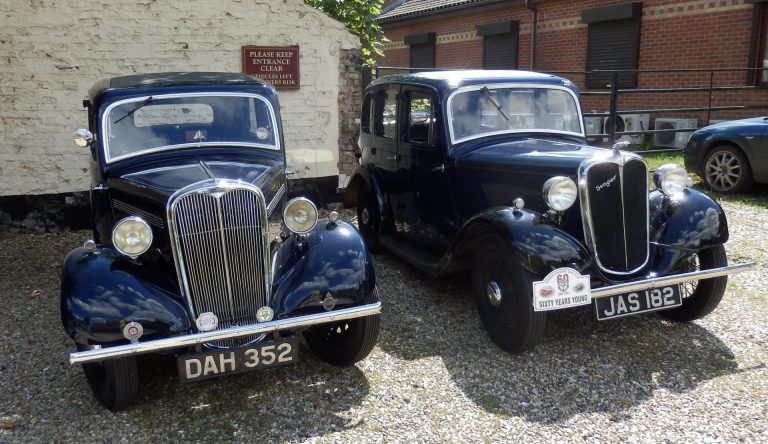
From Canterbury Street the Singers drove in convoy to the London Road Cemetery, where John Taylor had arranged for the cars to drive in and park by George’s grave-side.
John and Richard Hoare, our ‘Guardians of the Grave’, had placed on the grave bouquets of asparagus and maidenhair fern with white chrysanthemums, with which the grave had been lined for the funeral on 7th January 1909, and there
were cards to ‘George’  from ASCO and the SOC.
Barry’s partner Anne had made beautiful posies of red carnations, one for each of those present, and we laid these on the grave in a brief ceremony as a token of our respect, and in memory of   ‘George Singer, the Man’.
Following this, we spent a short while looking around this beautiful, historic place.
On the magnificent stair-case - in the steps of George Singer
The convoy then proceeded to Brownshill Green, where we met Tony Doughty, who has researched George Singer’s involvement in building of the Mission Chapel, for which he had laid one of the foundation stones, and in the Vicar Lane/Warwick Road Church in Coventry, where            
George worshipped, becoming a Deacon.  On the old communion table from Warwick Road, which George may well have used, Tony had laid out original documents, including a record of fundraising for the £200 needed to build the Mission chapel, where George recorded his subscription of £2. 2s. 0d.
This generosity was typical of George, and it is significant that
the Mission was to be a Sunday school for the increasing number of children in the area, which was not far from Coundon Court.  The Mission Minute Book also records a School Summer Treat outing to Coundon Court in 1889, when 70 children were served tea at the cottage and took part in all sorts of games, after which they were each given a bun by Mrs and the Misses Singer as they passed through the gates.    George’s interest in the chapel continued, and it is also recorded that in 1898 he offered £25 towards the building of the proposed new vestry.
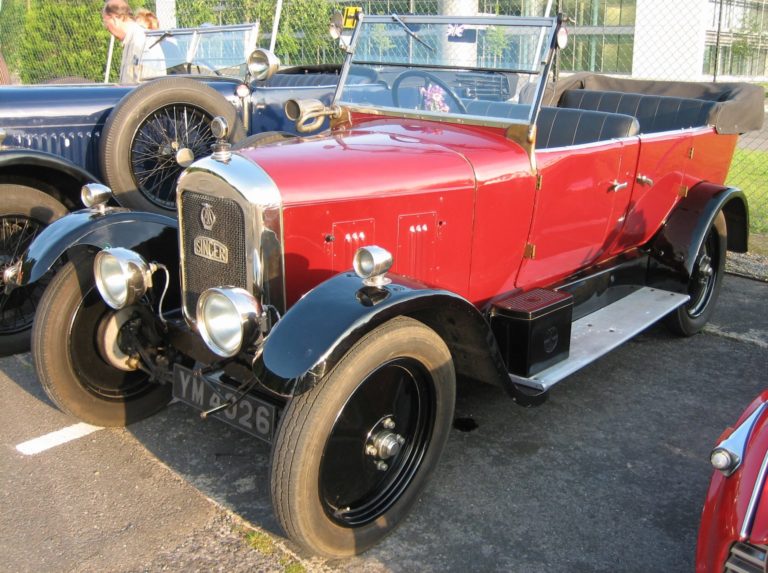
Kelsey and his wife Brenda, who had arrived in John Taylor’s 1925 Singer 10/26, guest speakers Lionel Bird and Richard Hoare, and George Singer’s great, great grand-daughter, Annabel Levaux.
In the evening we were to get even closer to George Singer, when we met at Warwick Road Church hall for a celebratory meal with our guests, Deputy Lord Mayor of Coventry Councillor Brian   
*            *          *           *            *           *            *            *            *             *            *            *
After an excellent meal, the Deputy Lord Mayor proposed a toast to George Singer, recalling his generosity in inviting 700 of Coventry’s children to a fancy dress ball in the city’s Corn Exchange, and his quests to introduce electric street lighting and to improve the city’s sewer system.
George was also instrumental in building the new municipal swimming baths, for which he laid the foundation stone in October 1892.
Guest speaker Lionel Bird then gave us a memorable talk about George Singer, based on his research for a book on the history of the Coventry City Football Club.
Throughout his research there had emerged a common thread, which always seemed to lead back to the fact that George Singer was a philanthropist in the true sense of the word, and that he cared deeply about the well-being of people and particularly his workforce.
He was ahead of his time in the field of working relations with his employees, who worked long hours over a 5½ day week.  George created a close bond with his workers, encouraging recreational activities by allowing time off, and supporting the creation of sporting and social clubs, including Cycling and Motor-Cycling Clubs, Cricket Club, Athletics Association, Rugby Union Team and, in 1883, the Singers Football Team.
Highlight of the year for many of his employees was the annual Company Picnic, paid for by George.  In 1889 the picnic was held at the house and grounds of Lord Leigh’s Stoneleigh Deer Park.  450 cyclists went to Stoneleigh via Kenilworth, the procession being led by Singer’s Apollo Band  on their multiple-seater ‘Victoria’ bicycle. The picnic included 224lbs of strawberries and 1200 cartons of fizzy water.  For the night-time return journey the cyclists lit their way home with Chinese lanterns.
The Motor-cycling Club was formed in 1910, and in 1913 George Stanley, nick-name ‘Wizard’, won 34 races, including 16 World Records!  It was Willie Stanley, his uncle, who formed the Singers Football Club and was their first player/manager. All the players were Singer employees, and              
George Singer would close the factory early so that the staff could attend important home games.
In 1888 James Morgan was appointed manager and he transformed the club.  In 1890/91 the team won the Birmingham Junior Cup at the Perry Barr ground.  1000 Singer supporters travelled by train and a further 1500 cycled to the match.
In 1898 the club changed its name to Coventry City Football Club.
George Singer earned the total respect of his employees, who regarded him in the highest esteem. On his death, six employees were coffin bearers, and a letter of condolence from the workforce to Mrs Singer read:
         *              *               *              *               *               *               *              *               *
Acknowledging George viewing the assembled Singer-folk from his picture on the wall, Richard speculated that he might have addressed us in the form of a rhyming couplet, and with the words from the SM advertisement in mind, recited his verse on George’s behalf:
Here was my place of worship, on Sundays throughout the years
High collars and tailcoats, top hats, regalias
We’d drive in convoy from Coundon past lanes so English and true
Humming tunes by Elgar down Holyhead Road we flew
A bumpy ride that first car but gleaming and highly polished,
As citizens stood and marvelled, seemingly quite astonished.
The years had sped by since Stinsford, my village when I was young
And the beauty of the country, to me has always sung
Rustic oratorios, the rhythmic hum of honey bees
Symphonies of Dorset tempests, the music of the trees,
So different from dear Coventry, the grasping and the grind,
Where I came as fate dictated, my destiny to find
Eliza then I married, onto Starley then my dream
Came the ordinary, the farthing, the Challenge and all did seem
That fortune was my friend now and life had certainly taught
That quality was foremost and this lead to Coundon Court
Here among cedars, the oak, the flowing streams
My sanctuary, my haven, a fusion of my dreams
English oak, mahogany, craftsmanship so fine
Elegance, harmony, a landscape so sublime
Here my children flourished, daughters Minnie & Louise
Arthur Leonard & Ernest ah the servants they did tease
Then Singer FC I founded and a Councillor became
A respected city father, Mayor and local fame
Know the Man - by Richard Hoare
 © Richard Hoare 2009
The rest they say is history, the Singer family survives
Uniquely down in Dorset where my Annabel now thrives
I watch you all here from heaven, among the auto pioneers
Edwin Perks & Harold Birch, Lea Francis, such engineers,
Three cylinder 1400s, engines by Poppe and White,
Thank you SOC & ASCO for keeping their names so bright,
My cars are still respected, loved and even sold,
Kevins & Barrys and Arthurs & Johns rebuild engines so I’m told,
Crankshafts are reground, con rods epicyclic
Bearings & clamps with nose cones make members quite orgasmic
And even 12 volt lighting gives members’ wives a thrill
Imagining a magneto with milled nuts would surely need some skill
So in leaving you this evening I thank you from my heart
For maintaining my memory not letting it depart
Whilst Canterbury Street remains & Coundon Court too
Your enthusiasm, your passion keeps everything so new
Remember “The man in the Singer is the man in the know”
But the Singer in the man is the one that you know.     
The final part of our ‘George Singer’ commemoration was a visit to Coundon Court on the Saturday morning, when Richard gave us another of his magical guided tours, complete with the stories of his sightings of George at the children’s bedroom window and the psychic who felt a presence at the very same spot. But ghosts or no ghosts, one thing for certain is that George is there in the quality and magnificence of his beautiful home.
This event was not club specific and we were very pleased to see members of both UK Singer clubs represented throughout the weekend. We are extremely grateful to SOC Chairman Arthur Michell for facilitating this co-operation, and for his friendship and support.
There is one person who has been an absolute stalwart with his enthusiastic encouragement throughout this George Singer Centenary year. Without his constant input of information and ideas the whole initiative may not have taken place. I am referring of course to Singer enthusiast and accomplished 10/26 driver John Taylor.
Thank you John for all you have done, and particularly for your efforts together with Richard Hoare as guardians of George Singer's grave.  We are also most grateful to Richard for the huge amount he has contributed to the George Singer Centenary.
     *              *              *              *              *             *             *             *              *               *

“A deep feeling of regret was felt by the workforce on hearing of the sad and sudden bereavement which has fallen upon you and your family.  The workpeople feel the loss immensely, and knowing your sorrow, they desire most earnestly to ask you to receive their sincere sympathy.”

*     *     *     *     *     *     *     *     *

*           *           *            *            *            *            *            *            *            *            *            *            *